

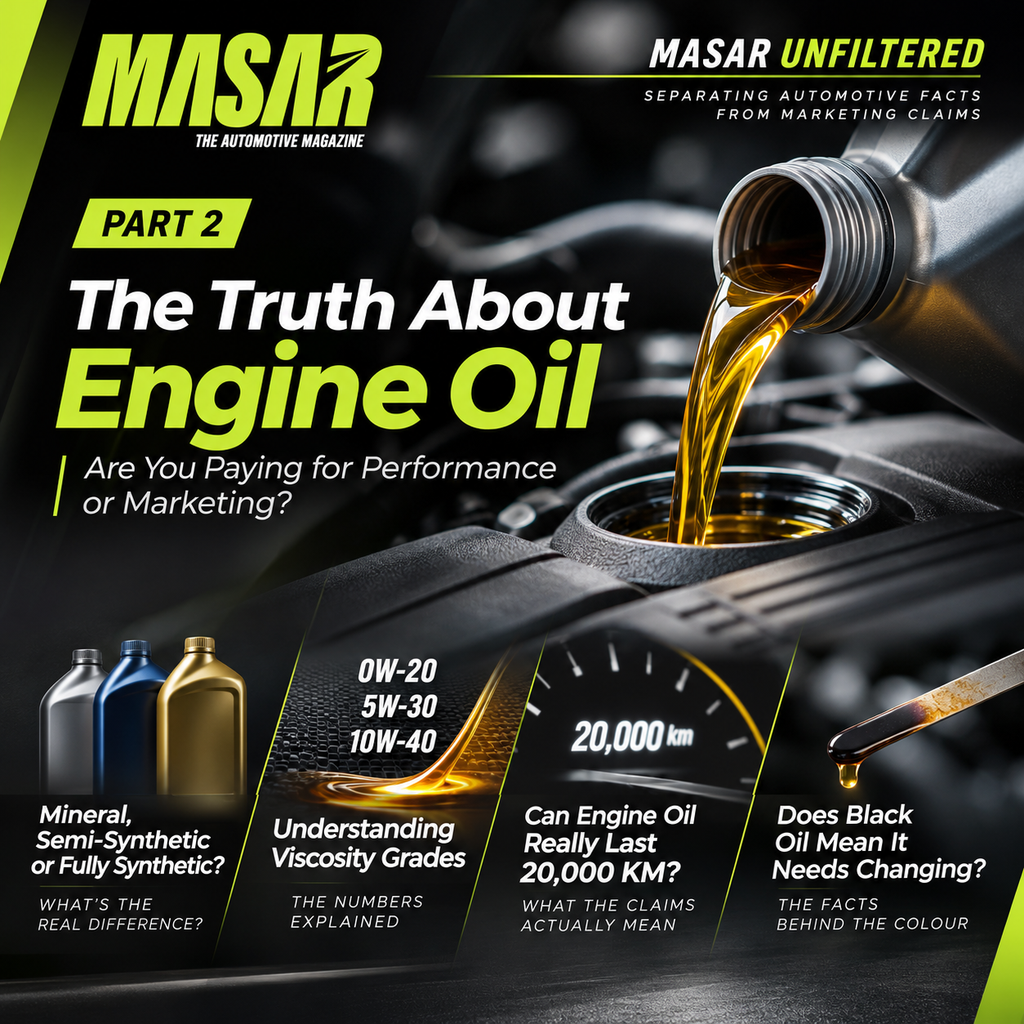
Fully synthetic, extended protection, advanced technology and 20,000 km performance. Engine oil packaging is filled with impressive claims, but what do they actually mean for Saudi motorists?
Engine oil is among the most frequently purchased automotive maintenance products, yet it remains one of the least understood.
With dozens of brands, viscosity grades, technical specifications and marketing claims competing for attention, choosing the right lubricant can become unnecessarily complicated.
Does synthetic oil always provide better protection? Is thicker oil better for Saudi Arabia’s climate? Does black engine oil need immediate replacement?
The answers may surprise you.
Mineral vs. Semi-Synthetic vs. Fully Synthetic Oil
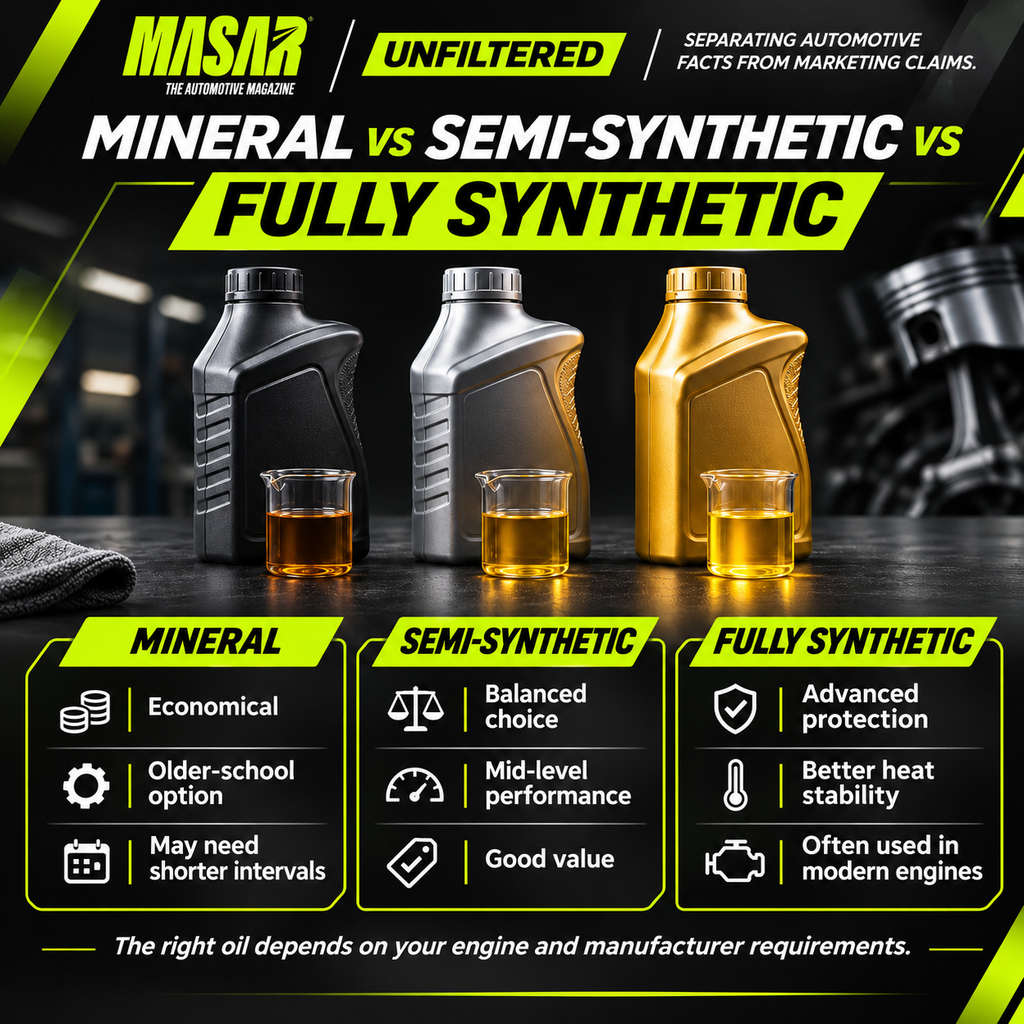
Engine oils are generally marketed under three main categories, each offering different characteristics.
Mineral Oil
Produced from refined petroleum base oils, mineral lubricants are typically more economical and may be suitable for engines designed to use them.
Compared with high-quality synthetic formulations, conventional mineral oils may offer lower resistance to oxidation and thermal degradation.
Semi-Synthetic Oil
Semi-synthetic lubricants combine mineral and synthetic base oils, offering a balance between performance and affordability.
However, the term semi-synthetic does not automatically determine the oil’s quality or recommended replacement interval.
Fully Synthetic Oil
Fully synthetic lubricants may offer advantages in thermal stability, oxidation resistance, deposit control and low-temperature performance.
These characteristics can help support longer maintenance intervals in engines designed and approved for them.
However, the words fully synthetic alone do not guarantee superior performance or authorise extended oil change intervals.
The product’s technical specifications remain essential.
Understanding 0W-20, 5W-30 and 10W-40
One of the most common misconceptions among motorists in Saudi Arabia is that thicker engine oil provides better protection in hot weather.
Oil viscosity grades describe how a lubricant flows under standardised temperature conditions.
| Viscosity grade | General description |
|---|---|
| 0W-20 | Lower-viscosity operating-temperature grade used in many modern engines |
| 5W-30 | A widely used multigrade lubricant |
| 10W-40 | A higher operating-temperature viscosity grade specified for certain engines |
The number before the W relates to cold-temperature performance, while the second number represents the lubricant’s high-temperature viscosity classification.
These numbers do not indicate oil quality, maximum outdoor temperature or how many kilometres the lubricant can be used.
Modern engines are engineered around specific lubricant characteristics. Selecting thicker oil simply because Saudi Arabia experiences extreme summer temperatures may be inappropriate.
The best viscosity is the one approved by your vehicle manufacturer.
Can Engine Oil Really Last 20,000 KM?
Some lubricant manufacturers advertise extended protection of 15,000, 20,000 kilometres or more.
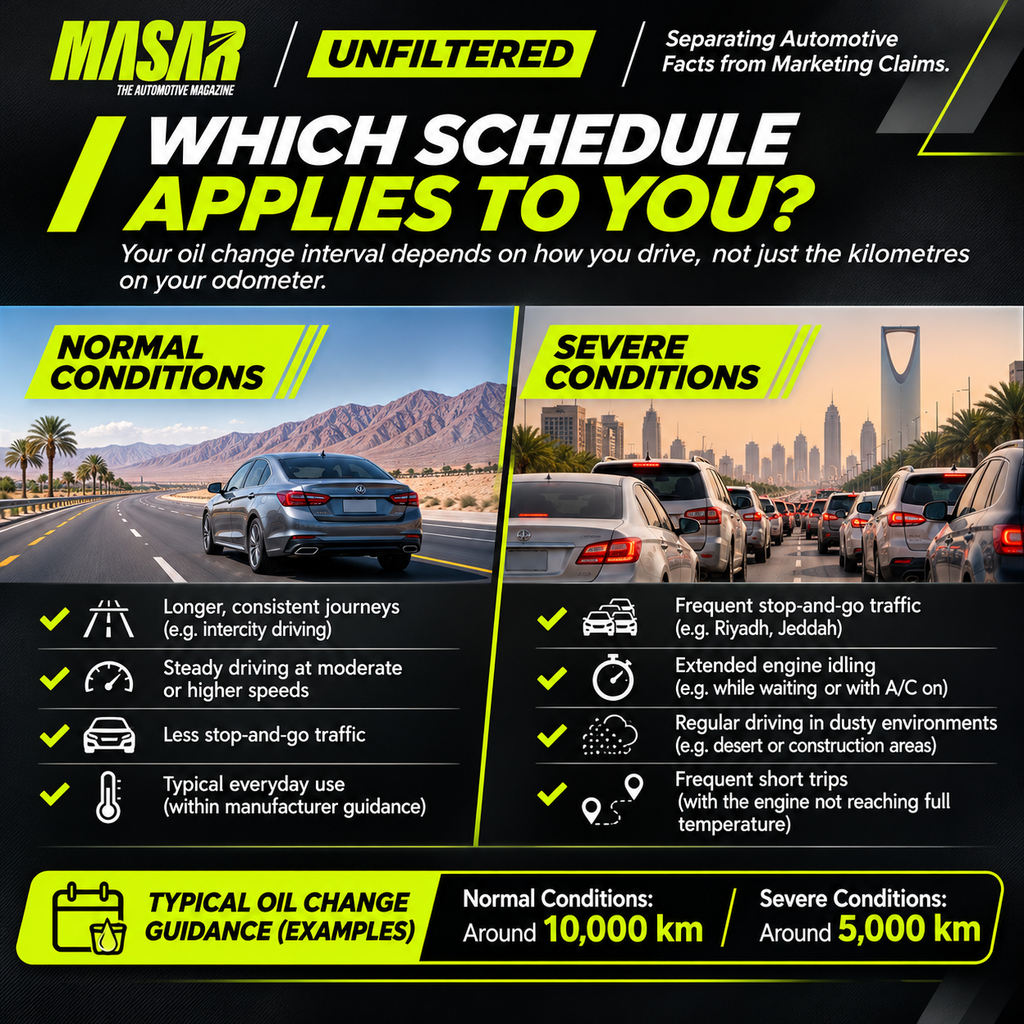
Although certain formulations may support extended-drain applications, these claims should never be treated as universal maintenance recommendations.
Oil service life depends on several factors:
- Engine design and condition.
- Lubricant specifications.
- Driving and environmental conditions.
- Oil filter capability.
- Manufacturer maintenance requirements.
A lubricant advertised for 20,000 kilometres does not override a vehicle manufacturer’s recommended 10,000 km replacement interval.
The advertised capability of the oil and the approved maintenance schedule of the vehicle are two different things.
Does Black Engine Oil Mean It Needs Changing?
Many motorists assume that dark engine oil has lost its protective properties.
However, modern lubricants contain detergents and dispersants designed to manage contaminants and combustion by-products.
Oil can therefore become darker as part of normal engine operation without necessarily becoming unsuitable for continued use.
Colour alone cannot accurately determine lubricant condition.
Professional oil analysis evaluates factors such as viscosity, oxidation, fuel dilution, contamination and wear metals to provide a more comprehensive assessment.
For everyday motorists, following the manufacturer’s maintenance schedule and regularly checking oil levels remain the most practical approaches.
What Matters More Than the Brand?
The most important information on an engine oil container is not necessarily the brand name or marketing slogan.
Motorists should pay attention to recognised performance classifications and manufacturer requirements.
| Specification | Purpose |
|---|---|
| SAE | Oil viscosity classification |
| API | Lubricant performance classification |
| ACEA | European lubricant performance requirements |
| ILSAC | Passenger-car engine oil performance standards |
| OEM Approvals | Vehicle manufacturer-specific requirements |
A more expensive oil is not automatically more suitable for your vehicle.
Conversely, a cheaper product should never be selected simply because it displays the same viscosity grade.
Two oils labelled 5W-30 may have significantly different performance specifications and manufacturer approvals.
Five Questions to Ask Before Buying Engine Oil
Before purchasing your next bottle of engine oil, consider these five questions:
- What viscosity does my vehicle manufacturer recommend?
- Which performance specifications and approvals are required?
- Does the selected oil meet those requirements?
- Is the product authentic and sourced from a reliable supplier?
- Am I following the correct oil and filter replacement interval?
These questions are more valuable than relying solely on brand reputation, price or packaging claims.
The MASAR Verdict
Modern lubricant technology has significantly improved engine protection and made longer maintenance intervals possible in appropriately designed engines.
However, automotive marketing can sometimes make choosing engine oil appear more complicated than necessary.
The correct lubricant is not automatically the most expensive, the thickest or the one promising the longest protection.
It is the lubricant that meets your engine’s engineering requirements and is used within its approved maintenance schedule.
Buy the specification, not the slogan.
MASAR UNFILTERED | The Automotive Magazine
Separating Automotive Facts from Marketing Claims.
Technical references: SAE viscosity classifications, API engine oil classifications, ACEA oil sequences, ILSAC standards and vehicle manufacturer maintenance guidance.




Leave a Reply