
With summer temperatures frequently exceeding 40°C, window tinting has become an essential consideration for Saudi motorists. But choosing the wrong film could result in fines of up to SAR 900. Here’s what drivers need to know about tinting regulations, heat protection, and the technology behind modern window films.
In Saudi Arabia, car window tinting is about much more than appearance or privacy.
With intense sunlight, high temperatures, and prolonged exposure to ultraviolet radiation, motorists increasingly rely on automotive window films to maintain cabin comfort and protect vehicle interiors.
However, not all window films are created equal, and not every tinting level is permitted under Saudi traffic regulations.
The General Department of Traffic has established rules intended to balance the benefits of window tinting with visibility, passenger safety, and road security.
In June 2026, Saudi Traffic reiterated that non-compliant vehicle window tinting carries fines ranging from SAR 500 to SAR 900.

For vehicle owners, understanding these requirements before visiting a tinting specialist can help avoid unnecessary penalties while ensuring the selected product delivers the desired level of protection.
Understanding Saudi Arabia’s Window Tinting Regulations
Under Saudi Traffic’s published guidance, permitted tinting must remain sufficiently transparent to allow visibility into the vehicle without restricting the driver’s view.
The commonly stated maximum tinting level is 30%, subject to the applicable window and vehicle restrictions.
The principal requirements include:
- Window film must remain sufficiently transparent.
- Tinting must not obstruct or reduce the driver’s visibility.
- Mirror-like or reflective tinting is prohibited.
- Images, patterns, decorations, or stickers that reduce visibility are not permitted.
- Tinting must comply with the requirements applicable to the specific vehicle and glass.
- Special medical circumstances may qualify for exceptions when supported by appropriate medical documentation.
Saudi Traffic’s June 2026 guidance discussed permitted tinting on side windows, including front and rear side glass, and rear-window tinting within the stated limit.
However, motorists should distinguish between side windows, the rear windscreen, and the front windscreen, as restrictions are not identical.
Drivers should confirm the currently applicable requirements for each glass position before installation, particularly when considering tinting beyond the rear passenger windows.
What Do Tinting Grades 00, 01 and 02 Mean?
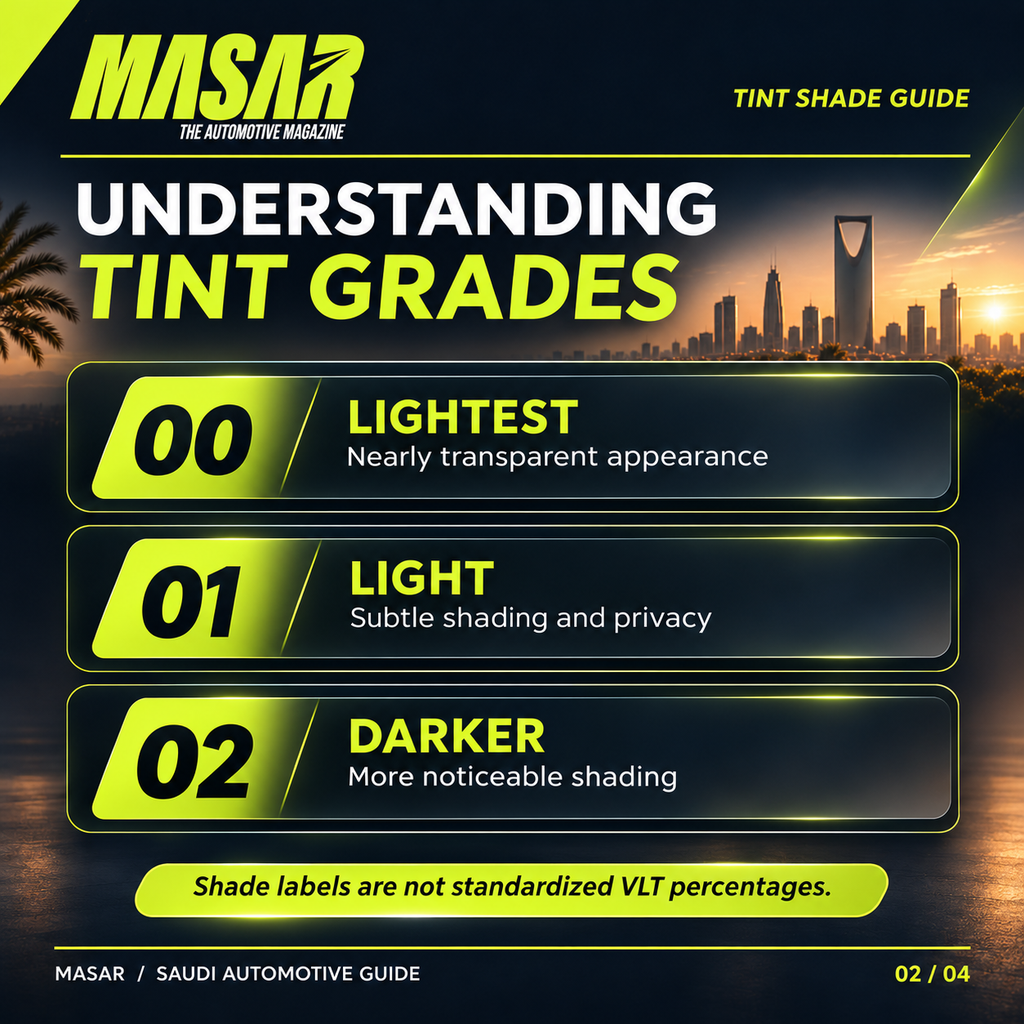
Automotive tinting businesses in Saudi Arabia commonly use three commercial shade descriptions: 00, 01 and 02.
These labels are intended to help customers identify different levels of darkness, although exact specifications can vary between manufacturers.
Grade 00 — Nearly Transparent
Grade 00 is generally the lightest option, offering minimal visible darkening.
It is suitable for motorists who prioritize clear visibility and prefer an almost factory-glass appearance.
Modern high-transparency films may still provide substantial ultraviolet protection and solar heat rejection without significantly changing the appearance of the glass.
Grade 01 — Light Tint
Grade 01 provides a more noticeable shade while retaining relatively high visibility.
It is commonly selected by motorists seeking a balance between passenger privacy, daylight visibility, and solar protection.
Grade 02 — Darker Tint
Grade 02 is generally darker than Grades 00 and 01 and may offer increased privacy.
It is commonly associated with the maximum tinting level permitted under applicable Saudi Traffic requirements.
However, a product sold as Grade 02 should not automatically be assumed to comply with the law.
The film’s actual light transmission, the vehicle’s original glass, and the location of installation must all be considered.
A Common Misunderstanding: Tint Percentage vs. Light Transmission
One of the biggest mistakes motorists make is confusing how dark a film appears with how much visible light it allows to pass through.
Visible Light Transmission, or VLT, measures the proportion of visible light passing through the glass.
For example, a film rated at 70% VLT allows approximately 70% of visible light to pass through the film itself.
A 30% VLT film, by comparison, transmits considerably less light and appears much darker.
These figures should not be confused with the 30% tinting limit referenced in Saudi Traffic guidance.
Furthermore, the final light transmission of a tinted window depends on both the film and the vehicle’s original factory glass.
This is why drivers should request documented specifications and, where possible, a measurement of the completed installation rather than relying on commercial shade names alone.
Does Darker Tint Mean Better Heat Protection?
Not necessarily.
Modern automotive film technology has advanced considerably, allowing manufacturers to develop products that reject substantial solar heat while maintaining relatively high visible-light transmission.
This distinction is particularly important for Saudi Arabia, where heat protection is often a greater priority than privacy.
Window films are commonly promoted using three performance measures.
Ultraviolet Rejection (UVR)
This indicates how much ultraviolet radiation the film blocks.
High-quality automotive films can provide strong UV protection, helping reduce exposure and protecting interior materials from sunlight-related deterioration.
Infrared Rejection (IRR)
Infrared rejection describes a film’s ability to reject infrared radiation within specified wavelengths.
However, IRR figures are not always directly comparable between manufacturers because testing methods and wavelength ranges can differ.
Total Solar Energy Rejected (TSER)
TSER measures the overall proportion of solar energy rejected by the glazing system, making it a particularly useful figure when evaluating heat-control performance.
Motorists comparing products should examine verified TSER ratings alongside visible-light transmission rather than selecting a film purely because it appears darker.
A lighter, high-performance film may provide better overall heat management than an inexpensive dark film.
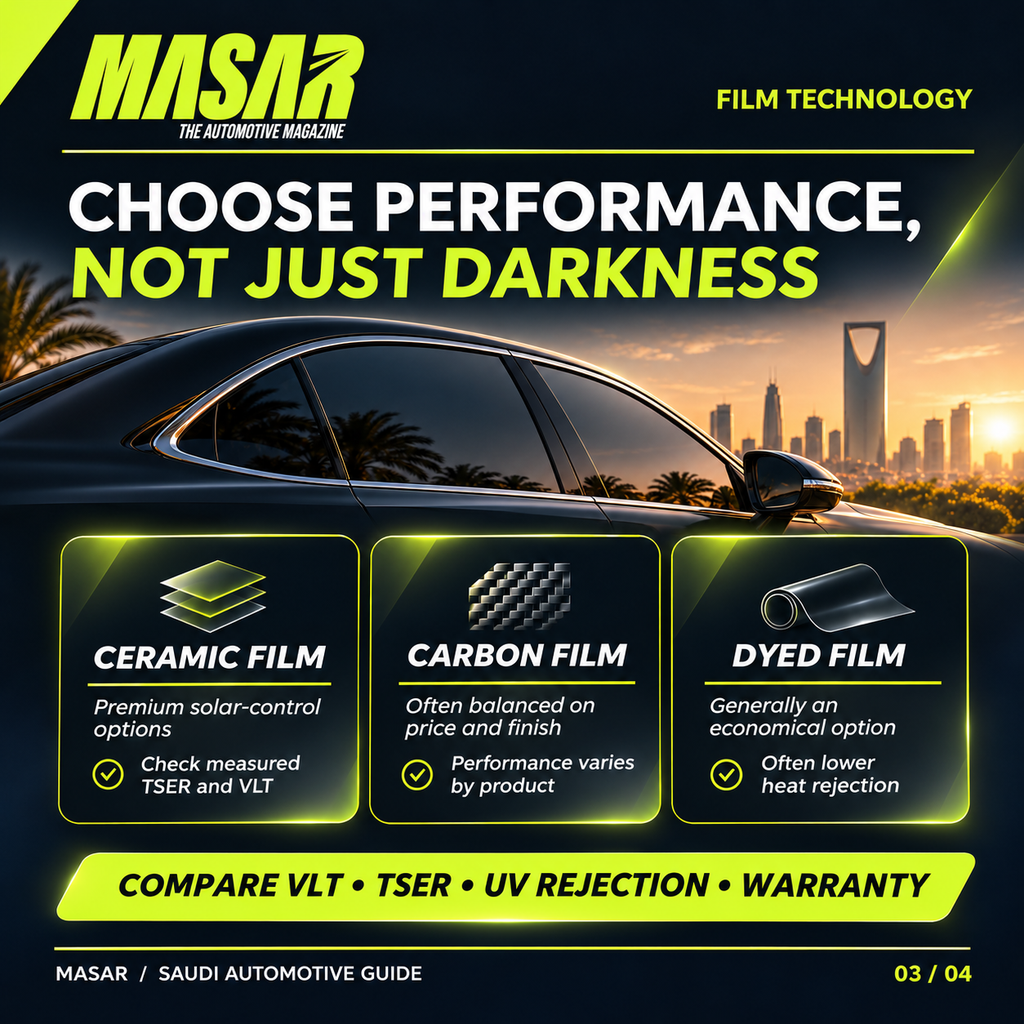
Ceramic, Carbon and Dyed Window Films: What’s the Difference?
The type of window film can significantly affect its performance, appearance, durability, and price.

Ceramic Window Films
Ceramic films use specialized non-metallic materials designed to manage solar radiation while maintaining optical clarity.
Depending on the product, their advantages may include high heat rejection, good UV protection, and reduced risk of interference with electronic signals.
They are commonly positioned in the premium automotive tinting segment.
Carbon Window Films
Carbon-based films generally offer improved color stability and solar-control performance compared with basic dyed alternatives, although performance varies considerably between products.
They can provide a practical balance between appearance, heat management, and cost.
Dyed Window Films
Dyed films are generally among the more economical options.
They primarily reduce visible light and glare, but their overall heat-rejection performance can be more limited than that of higher-performance alternatives.
Lower-quality products may also experience fading, discoloration, or deterioration over time.
For motorists in Saudi Arabia, selecting a film based on tested performance and warranty coverage is more important than choosing based on material labels alone.
Are All Vehicles Allowed to Have Tinted Windows?
No.
Saudi tinting regulations distinguish between vehicle categories, and some types face additional restrictions or exclusions.
These have included public taxis, daily rental vehicles, goods transport vehicles, buses operating within cities, and certain sports cars without separate rear passenger accommodation.
Vehicle configuration also matters.
For example, a two-door sports car without separate rear passenger windows may be treated differently from a passenger vehicle with dedicated rear seats and rear side glass.
Before installation, owners of commercial, rental, or specialist vehicles should verify their eligibility under the applicable traffic requirements.
Illegal Window Tinting: Fines of SAR 500 to SAR 900
Saudi Arabia classifies tinting that fails to comply with the competent authority’s requirements as a traffic violation.
Under the published penalty schedule, fines range from SAR 500 to SAR 900.
Examples of potentially non-compliant tinting include excessively dark windows, prohibited reflective materials, and films that obstruct visibility.
Importantly, violations are not limited to the degree of darkness.
A film may also be unsuitable if it affects the driver’s ability to identify pedestrians, vehicles, road markings, or hazards, particularly during nighttime driving.
For motorists, the safest approach is to confirm compliance before installation rather than waiting for a roadside inspection.
Can Drivers Obtain a Medical Exemption?
Saudi Traffic guidance recognizes that certain medical conditions may justify exceptions to the standard tinting restrictions.
Such cases require supporting medical documentation and compliance with the relevant authority’s procedures.
A medical condition alone should not be interpreted as automatic permission to install darker tinting.
Drivers should obtain confirmation of the applicable exemption requirements before modifying their vehicles.
How to Dispute a Window Tinting Fine Through Absher
Motorists who believe a traffic violation was incorrectly issued can submit an electronic objection through the Absher platform.
The process generally involves:
- Logging in to Absher Individuals.
- Selecting My Services.
- Opening Traffic Services.
- Choosing Dispute Traffic Violations.
- Reviewing the registered violation.
- Submitting an objection with the relevant explanation and available supporting evidence.
According to Absher’s published conditions, objections generally must be submitted within 30 days of the violation’s registration.
Additional restrictions apply to previously decided objections and cases where another electronic objection remains under review.
How to Choose the Right Window Film in Saudi Arabia
For vehicle owners considering window tinting, the product selection process should extend beyond appearance and price.
A reputable automotive film installer should be able to explain the product’s technical characteristics, supported by manufacturer documentation.
Before purchasing, motorists should consider several important questions.
Does the film comply with Saudi regulations?
The installer should identify the permitted glass positions and provide clear information about film transparency.
What is the film’s verified heat-rejection performance?
Request VLT, TSER, and UV-rejection specifications rather than relying solely on advertised infrared-rejection claims.
Will the tint affect nighttime visibility?
Dark films can make pedestrians, vehicles, and road hazards more difficult to identify in low-light conditions.
Does the installation include a warranty?
Check whether the warranty covers bubbling, peeling, discoloration, and installation defects.
Is the installer experienced?
Poor installation can result in trapped contamination, optical distortion, damaged trim, and premature film failure.
A professional installation should preserve visibility while delivering consistent coverage and long-term performance.
Frequently Asked Questions
Is Grade 02 tint legal in Saudi Arabia?
Grade 02 is commonly associated with a permissible commercial tinting level, but compliance depends on actual transparency, the window being tinted, and the vehicle category. The label alone does not establish legality.
Can the front windscreen be tinted?
The front windscreen is subject to stricter visibility requirements and should not be treated as having the same tinting allowance as side glass. Drivers should verify the current official requirements before applying any film.
Are reflective or mirror-finish films permitted?
No. Saudi Traffic prohibits mirror-like window tinting.
Can a transparent film still block heat?
Yes. Modern high-performance films can provide significant solar-energy rejection while maintaining relatively high visible-light transmission.
What is the penalty for illegal window tinting?
The published traffic fine ranges from SAR 500 to SAR 900.
Can a medical condition justify darker tint?
Certain medical cases may qualify for an exception, subject to appropriate documentation and the relevant authority’s requirements.
Does a higher price guarantee a better tint?
Not necessarily. Buyers should compare documented performance specifications, optical clarity, manufacturer warranties, and installation quality.
The Bottom Line: Choose Performance, Not Just Darkness
Saudi Arabia’s climate makes window tinting an attractive investment for many vehicle owners.
However, the best automotive window film is not necessarily the darkest or most expensive option.
Advances in solar-control technology mean motorists can increasingly obtain meaningful heat and ultraviolet protection without sacrificing visibility.
At the same time, compliance with Saudi Traffic regulations remains essential.
Choosing the correct film, confirming permitted installation locations, and working with a qualified installer can help motorists achieve the benefits of tinting without unnecessary legal or safety risks.
For Saudi drivers, the smartest window tint is one that keeps the cabin cooler, maintains clear visibility, and stays within the law.
References: Saudi General Department of Traffic; Saudi Ministry of Interior Traffic Violation Schedule; Absher; Saudi window-tinting guidance published in June 2026.
Editorial note: Commercial tint grades and manufacturer light-transmission ratings are not interchangeable with the legal tinting percentage. Vehicle owners should verify current glass-position and vehicle-category restrictions before installation.



Leave a Reply