

From speeding and mobile phone use to running red lights and driving without a licence, here’s what motorists need to know about traffic violations in Saudi Arabia.
Saudi Arabia continues to enforce strict traffic regulations as part of its efforts to improve road safety, reduce accidents, and encourage responsible driving across the Kingdom.
The General Department of Traffic, operating under the Ministry of Interior, oversees traffic enforcement through roadside monitoring, traffic patrols, and automated systems such as Saher.
Traffic violations are classified according to their severity, with standard penalties ranging from SAR 100 to SAR 10,000. More serious offences, including dangerous driving and driving under the influence, carry significantly higher fines.
For drivers navigating Saudi Arabia’s roads, understanding these regulations is essential for avoiding penalties and protecting other road users.
Saudi Arabia Traffic Fine Categories for 2026
The Kingdom’s standard traffic violation schedule is divided into seven main categories, with penalties increasing according to the seriousness of the offence.
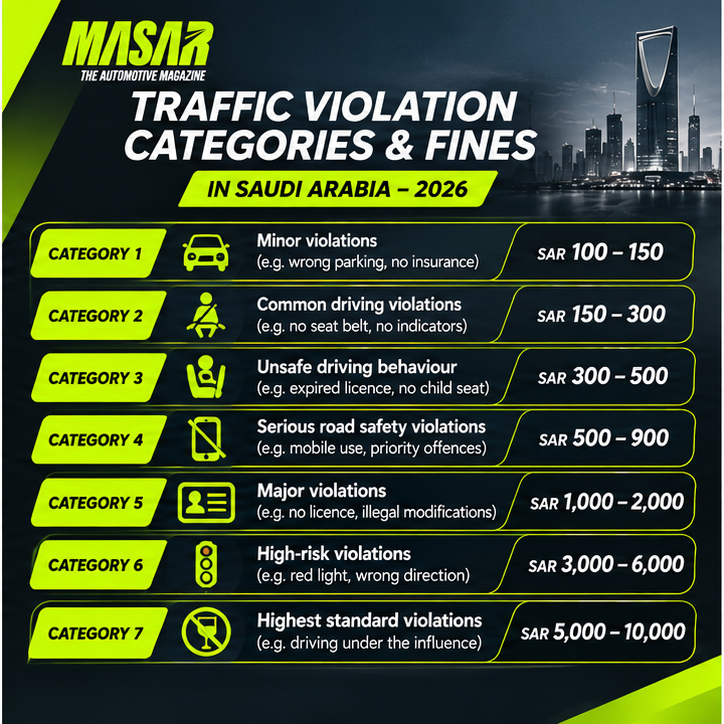
| Category | Fine Range |
| Category 1 | SAR 100–150 |
| Category 2 | SAR 150–300 |
| Category 3 | SAR 300–500 |
| Category 4 | SAR 500–900 |
| Category 5 | SAR 1,000–2,000 |
| Category 6 | SAR 3,000–6,000 |
| Category 7 | SAR 5,000–10,000 |
Certain violations, including speeding and drifting, are subject to additional specific penalty schedules.
Category 1: Minor Traffic Violations — SAR 100 to SAR 150
The first category covers relatively minor offences involving parking, vehicle operation, and pedestrian safety.
Common violations include:
- Parking in areas not designated for parking.
- Leaving a vehicle unattended while its engine is running.
- Operating a vehicle without valid insurance.
- Driving in areas where vehicle access is prohibited.
- Pedestrians crossing outside designated crossings.
- Failing to give pedestrians priority at designated crossings.
Although these carry the lowest penalties, repeated violations can result in substantial cumulative fines.
Category 2: Everyday Driving Violations — SAR 150 to SAR 300
This category includes some of the most common driving offences in Saudi Arabia.
Violations include:
- Failing to wear a seat belt.
- Changing lanes or turning without using indicators.
- Failing to maintain a safe following distance.
- Failing to carry a driving licence or vehicle registration.
- Missing the required periodic vehicle inspection.
- Misusing the vehicle horn.
- Reversing for more than 20 metres on a public road.
- Obstructing the driver’s visibility.
- Gathering around traffic accident scenes.
- Improper use of road shoulders to bypass traffic.
These regulations aim to promote safer driving habits and reduce preventable accidents.
Category 3: Unsafe Driving Behavior — SAR 300 to SAR 500
The third category addresses driving practices that may create unnecessary risks or disrupt traffic flow.
Common offences include:
- Driving with an expired driving licence.
- Using brakes suddenly without a legitimate reason.
- Driving too slowly in a manner that obstructs traffic.
- Failing to remain within designated lanes.
- Driving while distracted.
- Throwing objects from moving vehicles.
- Failing to use approved child safety seats.
- Leaving children under the age of ten unattended in a vehicle.
- Failing to take appropriate precautions when parking on slopes.
Child passenger safety remains particularly important, with dedicated regulations intended to reduce injuries in road accidents.
Category 4: Serious Road Safety Violations — SAR 500 to SAR 900
This category includes offences that can significantly increase the risk of road accidents.
Examples include:
- Using a handheld mobile phone while driving.
- Failing to stop completely at a stop sign.
- Failing to give priority to vehicles already inside a roundabout.
- Parking in spaces reserved for people with disabilities without authorization.
- Following emergency vehicles responding to incidents.
- Driving inside tunnels without headlights.
- Failing to observe priority rules at intersections.
- Installing vehicle window tinting that does not comply with regulations.
- Operating a vehicle that causes environmental pollution.
- Transporting unsecured or uncovered loads.
Mobile phone use while driving remains an important enforcement concern because even brief distractions can compromise a driver’s ability to respond to sudden hazards.
Category 5: Major Traffic Violations — SAR 1,000 to SAR 2,000
The fifth category covers more serious offences involving vehicle licensing, road safety, and unauthorized vehicle modifications.
These include:
- Driving before obtaining a driving licence or after licence withdrawal.
- Driving with a licence that does not match the vehicle category.
- Driving without a front number plate.
- Using damaged or illegible number plates.
- Overtaking in prohibited areas.
- Driving on pavements or prohibited road shoulders.
- Driving without necessary vehicle safety equipment.
- Operating a motorcycle without a helmet.
- Making unauthorized structural modifications to a vehicle.
- Driving without headlights when required at night or during poor visibility.
- Exceeding permitted passenger capacity.
- Failing to give priority to emergency or official convoy vehicles.
These penalties highlight the importance of ensuring vehicles remain roadworthy, correctly registered, and operated by properly licensed drivers.
Category 6: High-Risk Traffic Violations — SAR 3,000 to SAR 6,000
Some of the Kingdom’s most dangerous traffic offences fall within the sixth category.
Violations include:
- Running a red traffic light.
- Driving against the direction of traffic.
- Overtaking school buses while passengers are boarding or exiting.
- Recklessly weaving between vehicles at high speeds.
- Participating in unauthorized road races.
- Failing to stop at security checkpoints when instructed.
- Tampering with traffic signs or road safety equipment.
- Installing unauthorized emergency vehicle equipment.
- Operating heavy vehicles outside designated lanes where required.
Running a red light is among the most significant traffic violations, with penalties ranging from SAR 3,000 to SAR 6,000.
Category 7: The Highest Standard Traffic Fines — SAR 5,000 to SAR 10,000
The seventh category applies to particularly serious offences that place lives and public safety at risk.
These include:
- Driving under the influence of alcohol or drugs.
- Driving after taking medication that carries a warning against operating vehicles.
- Concealing or tampering with a vehicle’s chassis identification number.
- Using unauthorized vehicle number plates.
- Carrying out roadworks without the required coordination.
- Crossing flooded valleys or waterways during dangerous conditions.
Beyond the financial implications, these offences can carry additional legal consequences depending on the circumstances.
Speeding Violations in Saudi Arabia
Speeding remains one of the most frequently discussed traffic offences in the Kingdom.
Saudi Arabia uses automated monitoring systems, including Saher cameras, to detect vehicles exceeding posted speed limits.
Unlike the seven general categories, speeding penalties depend on the road’s posted speed limit and the extent to which a driver exceeds it.
Drivers should therefore pay close attention to posted limits, particularly when travelling between urban roads, expressways, and highways.
Traffic Fine Discounts: What Drivers Should Know in 2026
Saudi Arabia previously introduced a temporary 50% reduction for eligible accumulated traffic violations recorded before April 18, 2024.
However, this temporary initiative ended on April 18, 2025, with the Ministry of Interior announcing the conclusion of the extended discount period.
A separate provision under Article 75 of the Saudi Traffic Law allows eligible individual fines to be reduced by up to 25%, subject to applicable regulations and conditions.
Drivers should distinguish between the expired 50% initiative and the separate Article 75 discount provisions.
How to Check and Manage Traffic Violations Through Absher
Motorists can access traffic-related services through the government’s Absher platform.
Services include reviewing registered violations, submitting objections, and requesting extensions of eligible fine payment deadlines.
To request a payment extension:
- Log in to the Absher platform.
- Select Services.
- Choose Traffic.
- Select Extending Deadline for Paying Traffic Violations.
- Review the terms and conditions.
- Submit the request for an eligible violation.
The extension service is subject to eligibility criteria, including the objection period and the deadline for submitting an extension request.
Frequently Asked Questions
What is the fine for running a red light in Saudi Arabia?
Running a red light carries a penalty ranging from SAR 3,000 to SAR 6,000.
Is crossing a yellow traffic light a violation?
Proceeding through a yellow light is not, by itself, listed as the red-light violation. However, drivers must obey traffic signals and drive safely, and other unsafe conduct may result in penalties.
What is the fine for not wearing a seat belt?
The penalty ranges from SAR 150 to SAR 300.
What is the fine for using a mobile phone while driving?
Using a handheld mobile device while driving carries a fine of SAR 500 to SAR 900.
What is the fine for illegal parking?
Ordinary parking violations generally carry penalties of SAR 100 to SAR 150. However, parking in spaces reserved for people with disabilities without authorization carries a higher penalty of SAR 500 to SAR 900.
What is the fine for driving in the wrong direction?
Driving against traffic carries a fine of SAR 3,000 to SAR 6,000.
What is the fine for driving without a licence?
Failing to carry an existing driving licence generally carries a fine of SAR 150 to SAR 300.
Driving before obtaining a licence, or after a licence has been withdrawn, carries a higher fine of SAR 1,000 to SAR 2,000.
Can drivers extend the deadline to pay a traffic fine?
Yes. Eligible motorists can request a payment extension through Absher, subject to the applicable conditions and deadlines.
Is the 50% traffic fine discount still available?
No. The temporary 50% discount initiative ended in April 2025. Eligible motorists may instead benefit from the separate provisions of Article 75.
Road Safety Remains the Priority
Saudi Arabia’s traffic regulations reflect the Kingdom’s continued focus on improving road safety and encouraging responsible driving.
From relatively minor parking offences to serious violations such as reckless driving and running red lights, the penalty structure is designed to discourage dangerous behaviour and promote compliance with traffic regulations.
For motorists, staying informed about traffic laws, keeping vehicle documents up to date, and maintaining safe driving habits remain the most effective ways to avoid penalties.
As automated enforcement and digital traffic services continue to support road safety across Saudi Arabia, understanding the rules is increasingly important for every driver.
Reference: Saudi Ministry of Interior, General Department of Traffic, Saudi Traffic Law, and Absher.


Leave a Reply